
Table of Contents
Introduction: What Is the Role of Exercise in Weight Loss?
Many people ask about the role of exercise in weight loss. They believe that exercising alone will burn fat and lead to a slimmer body. However, exercise in weight loss is just one piece of a larger puzzle. Understanding how your body actually burns calories—through basal metabolism, daily movement and food processing—is key to effective and sustainable fat loss.
The Bigger Picture: BMR, NEAT & TEF
To truly understand the role of exercise in weight loss, first consider three major components of energy expenditure:
1. Basal Metabolic Rate (BMR)
Your BMR is the energy your body uses just to keep basic functions going—breathing, blood circulation, maintaining body temperature, producing hormones—even when you’re resting. Because BMR accounts for the largest portion of calorie use, the role of exercise in weight loss must be seen in context of this baseline burning. If you sit all day and still feel hungry, your body used energy through BMR. That means even without moving much, your body is burning calories.
2. Non-Exercise Activity Thermogenesis (NEAT)
NEAT includes all the non-workout movements you make: walking around the house, doing chores, climbing stairs, fidgeting. These activities form a surprisingly large part of your daily calorie burn. In exploring the role of exercise in weight loss, it’s important to highlight that structured exercise is only a part of overall movement—and NEAT may contribute more than most expect.
3. Thermic Effect of Food (TEF)
This is the energy your body uses to digest, absorb and process your meals. While TEF contributes less than BMR or NEAT, it still matters when assessing the role of exercise in weight loss: how you eat, what you eat and when you eat have an impact on calorie use.
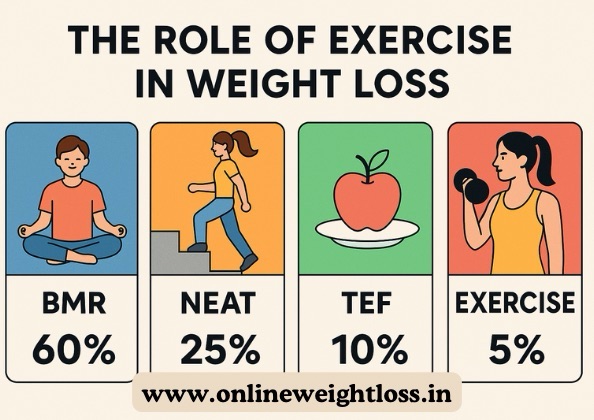
When you add up typical contributions, you might find: BMR around 60 %, NEAT around 25 %, TEF about 10 %—leaving structured exercise with around 5 %. So, the role of exercise in weight loss is real but relatively small when viewed alone.
Structured Exercise: How Much Does It Actually Help?
Now, let’s focus specifically on the exercise part of the equation and examine the role of exercise in weight loss more closely.
Research shows that structured exercise—such as aerobic workouts, resistance training or HIIT—does contribute to weight loss and body-fat reduction. For example:
A meta-analysis found that aerobic exercise (150+ minutes/week) was associated with significant reductions in body weight, waist circumference and body fat. Another review concluded that while the role of exercise in weight loss is modest in magnitude, it still provides meaningful body-composition benefits—especially when combined with diet.
So, exercise is beneficial—but if you focus ONLY on the exercise and ignore diet and daily movement, you’ll likely under-achieve. The role of exercise in weight loss cannot overshadow the bigger components of calorie use.
Why Exercise Alone Rarely “Burns Off” Poor Eating
If your goal is fat loss, relying purely on gym workouts and ignoring other components undermines the role of exercise in weight loss. Here’s why:
Structured exercise burns additional calories, but unless you eat in a calorie-deficit and keep your BMR and NEAT active, the total burn might be small. Extreme calorie restriction (e.g., too low intake) slows your BMR and reduces the effectiveness of exercise. You might think more exercise or less food = faster results, but over time the role of exercise in weight loss gets compromised by metabolic adaptation. Exercise helps preserve lean muscle mass, boosts metabolism slightly and improves overall health—so the role of exercise in weight loss includes more than just “burning calories.”
Practical Strategy: Make Exercise Work for You
Given the modest but meaningful role of exercise in weight loss, here are ways to make it count:
Pair your workouts with a moderate calorie-deficit (don’t reduce daily intake drastically). Increase NEAT by walking more, using stairs, standing instead of sitting and doing everyday tasks. Choose workouts you enjoy, so consistency supports long-term weight loss. Focus on muscle-preserving exercises (strength training) to support BMR. Keep your daily intake above the minimum threshold (often >1,200 calories) so your BMR stays active and your metabolism doesn’t backslide.
Conclusion: Understand the Full Role of Exercise in Weight Loss
To answer the question—what is the role of exercise in weight loss?—the answer is: important but partial. Exercise contributes to fat loss and body-composition change, but the bulk of calorie burning comes from your BMR, NEAT and TEF.
By understanding the full picture and aligning your diet, movement and workouts, you maximize your results. Don’t let the role of exercise in weight loss mislead you into believing it’s the only factor. True success comes from the sum of small parts.
Related Resources
For a deeper dive into daily movement and calorie use, read our article on Can We Lose Weight Without Exercise? which explains how BMR, NEAT and diet are more dominant.
For Detailed Weight Loss Guidance, Read Our Complete Guide to Healthy Weight Loss.
Check out this in-depth article from Scientific American on the true effects of exercise in weight loss – Does Exercise Help You Lose Weight?


3 thoughts on “What Is the Role of Exercise in Weight Loss?”
Comments are closed.