Table of Contents
Introduction
Do you feel like you are eating home-cooked Indian food but still not losing weight?
You are not alone. This is one of the most common problems people face during their weight loss journey.
Most people believe that eating “ghar ka khana” is enough for weight loss. But the reality is different. Even healthy food can lead to fat gain if eaten in large quantities. If you want to understand the core concept of fat loss, you should also check the Complete Guide to Healthy Weight Loss, where the fundamentals are explained in detail.
In this article, you will learn how to control portion size in Indian meals in a practical and realistic way, so you can lose weight without giving up your favorite foods.
Why Portion Control Matters More Than You Think
Weight loss is not just about what you eat—it is about how much you eat consistently.
Let’s understand this with a simple concept:
👉 If your body needs 1800 calories per day
👉 But you consume 2200 calories daily
You will gain weight—even if your food is healthy.
This is exactly where most people go wrong.
Example:
- Eating 4 rotis instead of 2
- Taking extra rice
- Adding extra oil unknowingly
These small habits increase calorie intake significantly.
Over time, this leads to:
- Fat gain
- Slow metabolism
- Difficulty in losing weight
This is why understanding how to control portion size in Indian meals is essential.
Real-Life Case Study (Very Important)
Case 1: Amit (IT Professional)
Routine:
- Breakfast: Paratha + tea
- Lunch: 4 rotis + sabzi
- Dinner: Rice + dal
Problem:
- No junk food
- Still gaining weight
Reason:
👉 Portion size too high
Case 2: Same Food, Better Portion
Changes:
- 2 rotis instead of 4
- Half rice portion
- Added salad and protein
Result:
- Lost 5 kg in 2 months
- Energy improved
👉 Same food, different quantity = different results
Understanding Indian Meal Imbalance
Indian meals are nutritious but often unbalanced.
Typical Plate Problem:
- Carbs (roti/rice) = High
- Protein = Very Low
- Oil = Hidden
- Fiber = negligible
This causes:
- Frequent hunger
- Overeating
- Fat storage
Plate Method (Most Powerful Technique)

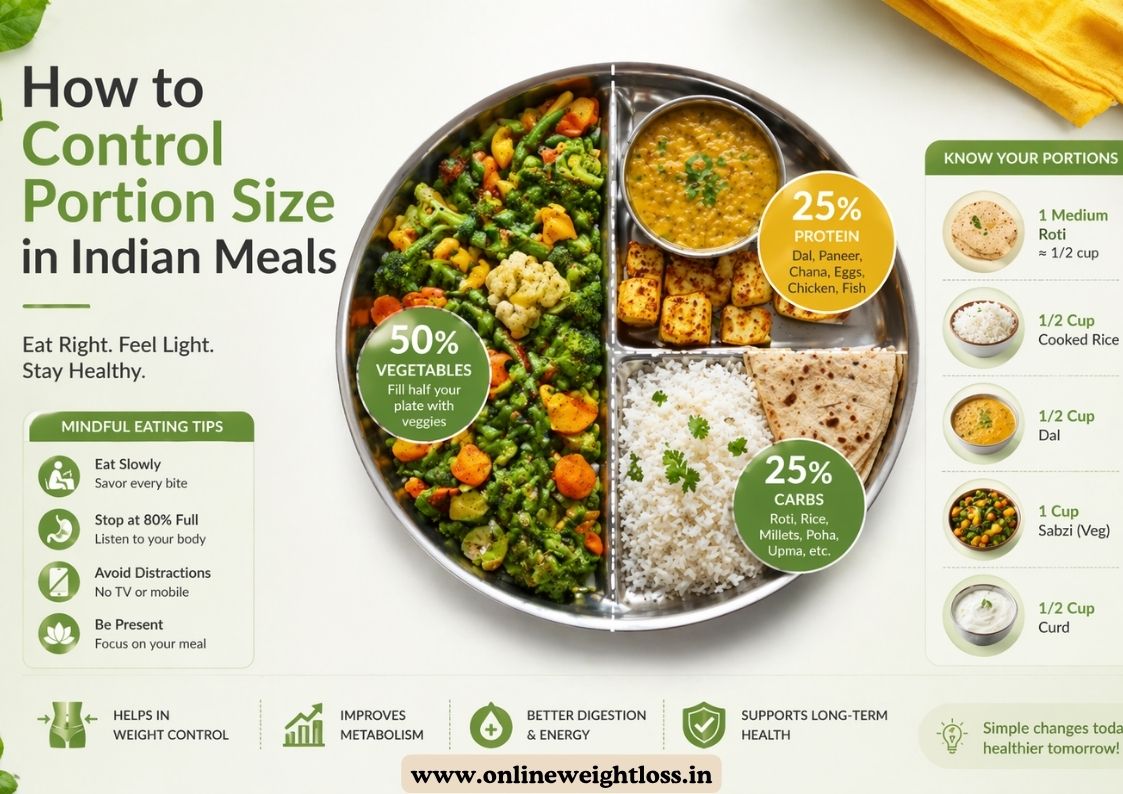
The simplest way to learn how to control portion size in Indian meals is by using the plate method.
Ideal Plate Division:
Plate 1:- Only Fibre ( 1 Quarter Plate for a Meal)
Plate 2:- Main Plate, which should consist
- 50% Vegetables
- 25% Protein
- 25% Carbs
Why This Works (Deep Explanation)
When half your plate is Only Fiber:
- Calories reduce automatically (Plate 2 Size automatically decreases)
- Fiber increases
- Fullness improves
When protein is included in second plate
- Hunger reduces
- Muscle is preserved
- Fat loss improves
When carbs are controlled:
- Insulin spikes reduce
- Fat storage decreases
- Glycemic Index reduces
👉 This balance creates a natural calorie deficit.
7 Proven Strategies (Explained Deeply)
1. Pre-Decide Your Portion
Before eating, decide:
- 2 rotis only
- 1 bowl rice
- Take whole meal at a time
This prevents impulsive eating.
👉 Without planning → overeating happens automatically.
2. Use Smaller Plates (Psychology Hack)
Your brain judges quantity visually.
- Big plate → looks less → you eat more
- Small plate → looks full → you eat less
This simple trick can reduce calorie intake by 15–20%.
3. Start with Protein
When you begin your meal with:
- Dal
- Paneer
- Eggs
You feel full faster.
👉 Result:
- Less roti
- Less rice
- Better portion control
4. Eat Slowly (Biological Reason)
Your stomach signals your brain about fullness after ~20 minutes.
If you eat fast:
👉 You overeat before the signal arrives
If you eat slowly:
👉 You stop naturally
5. Avoid Second Serving
Most overeating happens in second serving.
Rule:
👉 One plate = one meal
Wait 10 minutes before taking more.
6. Always Plate Your Food
Eating from:
- Cooker
- Kadai
- Serving bowl
Leads to:
👉 No portion awareness
Always serve your food first.
7. Fix Meal Timing
Irregular eating causes:
- Extreme hunger
- Loss of control
👉 Fixed timing = better portion discipline
Advanced Strategy: Eat Smart Without Counting Calories
You don’t need to count calories strictly.
Instead:
- Reduce carbs slightly
- Increase protein
- Increase vegetables
- increase Fibre
👉 This automatically controls portion size.
Common Mistakes (Deep Insight)
❌ “Healthy hai, jitna marzi khao”
Even healthy food has calories.
❌ Skipping breakfast
Leads to heavy lunch
❌ Weekend overeating
Destroys weekly deficit
❌ Liquid calories
Tea, juices, cold drinks add hidden calories
Pro Tips (Expert Level)
- Drink water before meals (reduces intake)
- Eat protein in every meal
- Stop at 80% fullness
- Track meals weekly
- Avoid emotional eating
Psychological Shift (Game Changer)
You need to change your thinking:
Old mindset:
👉 “Plate finish karni hai”
New mindset:
👉 “Body ko jitni zarurat hai utna hi khana hai”
This shift alone can transform results.
When Nutritional Shake Becomes Useful
Real-life situations:
- Busy mornings
- Office rush
- Travel
- No cooking time
👉 In such cases, a nutritional shake becomes a smart option.
Why it works:
- Fixed calorie intake
- Balanced nutrition
- No overeating
- Easy to consume
Real Example:
Amit replaced breakfast 4 days/week with a shake
→ Controlled calories
→ Lost 3 kg extra in 1 month
FAQs: How to Control Portion Size in Indian Meals
1. Can I eat rice daily?
Yes, if portion is controlled.
2. How many rotis are ideal?
1–2 per meal for most people.
3. Is portion control enough for weight loss?
Yes, if done consistently.
4. Do I need gym for this?
Not necessary, but helpful.
5. When will results show?
Within 3–4 weeks.
Conclusion
Understanding how to control portion size in Indian meals is one of the most effective and sustainable ways to lose weight. You don’t need to follow extreme diets—you just need to manage your food quantity smartly.
By applying strategies like the plate method, controlling carb portions, increasing protein and vegetables and eating mindfully, you can achieve long-term fat loss without giving up your favorite foods.
And when managing portions becomes difficult due to a busy lifestyle, using a nutritional shake as a controlled meal option can help you stay consistent. The real key is not perfection, but consistency and awareness.
Related Resources
Internal Resources
Complete Guide to Healthy Weight Loss
Complete system to understand fat loss.
Best Indian Breakfast for Weight Loss
Healthy breakfast options for fat loss.
Difference Between Weight Loss and Fat Loss
Understand why fat loss matters more.
External Resources
Healthy Eating Plate– Understanding Harvard’s science-based plate model and the right direction for balanced everyday nutrition.
Food Portions: Choosing Just Enough for You by National Institute of Health
Understanding portion control and the right direction to eat enough for health without overeating.
Author
Arun Dewangan
Health and Wellness Blogger focused on natural weight loss and sustainable lifestyle strategies.