Table of Contents
Introduction: Is Taking External Protein Safe for Health?
Many people have heard that consuming protein from external sources can damage the kidneys. This belief creates fear, confusion and hesitation—especially among gym-goers and people trying to improve their nutrition. So the real question is: is taking external protein safe for health or does it actually harm the kidneys?
The answer is not a simple yes or no. The truth is more specific and depends on one critical factor—the quality of the protein, which is measured by something called the PDCAAS score.
Understanding PDCAAS: The Real Deciding Factor
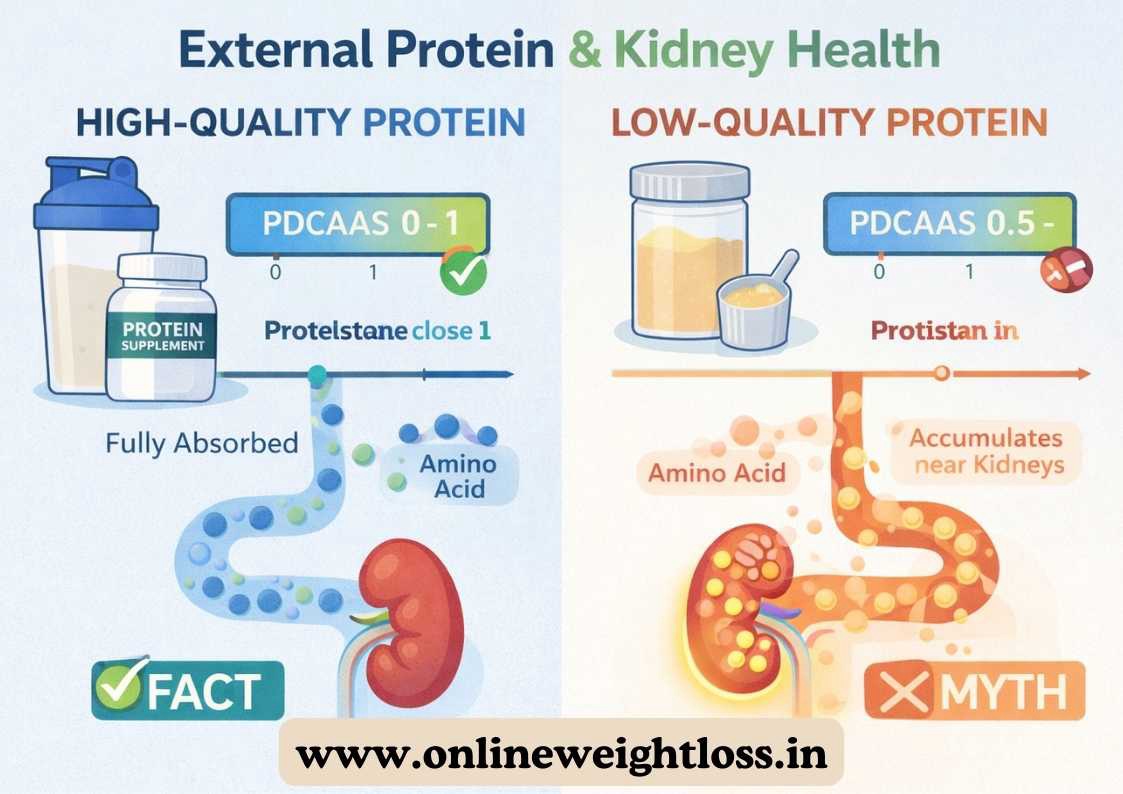
To understand whether is taking external protein safe for health, you must first understand PDCAAS, which stands for Protein Digestibility Corrected Amino Acid Score.
PDCAAS is a scientific score that:
- Ranges from 0 to 1
- Shows how much of a protein can actually be digested and absorbed by the human body
- Indicates the biological quality of a protein source
The closer the PDCAAS score is to 1, the higher the quality and absorption of that protein. A score close to 1 means your body can effectively utilize that protein without stress or waste.
When External Protein Can Harm the Kidneys
The statement “external protein damages kidneys” is not completely false, but it is true only in one specific situation.
When a protein powder has a low PDCAAS score, it is not fully absorbed by the body. The unabsorbed protein does not simply disappear. Instead:
- It begins to accumulate in the kidneys
- It may increase uric acid levels
- Over time, this accumulation can stress kidney function
This is the real reason why people experience kidney issues—not because protein itself is harmful, but because poor-quality protein is not absorbed properly.
So when people ask is taking external protein safe for health, the correct response is:
👉 It depends on the quality of the protein you are consuming.
Why Brand Quality Matters More Than Quantity
Many fitness enthusiasts calculate how much protein they need per day, but very few ask an important question:
Is the protein I’m consuming actually being absorbed?
If a protein supplement comes from a reputed brand and has a PDCAAS score close to 1, it does not cause harm to the kidneys or overall health. In fact, such protein supports muscle recovery, strength and metabolic function.
On the other hand, low-quality protein powders—often chosen because they are cheap or heavily marketed—are the real problem. This distinction is crucial when evaluating is taking external protein safe for health.
Absorption Matters More Than Calculation
Many people proudly say, “I consume 120 grams of protein per day.”
But the more important question is:
How much of that protein is your body actually absorbing?
If absorption is low, the body is forced to deal with excess waste. This is where kidney stress begins—not because protein is bad, but because the wrong protein is used.
This is why blindly following gym advice without understanding PDCAAS can be risky. Gym trainers may suggest quantity, but quality and absorption require deeper nutritional understanding.
Why Guidance Is Essential
To truly answer is taking external protein safe for health, guidance is essential. Protein supplementation should:
- Be selected based on PDCAAS score
- Come from a reputed, transparent brand
- Be consumed under the guidance of a qualified wellness coach
A wellness coach evaluates your body type, lifestyle, digestion and nutritional needs. This ensures that the protein you consume supports your health rather than harming it.
Protein should never be consumed simply because “everyone at the gym is taking it.”
Conclusion: Protein Is Not the Problem—Poor Quality Is
So, is taking external protein safe for health and kidney?
Yes—when the protein is of high quality and has a PDCAAS score close to 1.
Kidney damage occurs not because of protein itself, but because of:
- Poor-quality protein
- Low absorption
- Lack of proper guidance
When chosen wisely, external protein is safe, effective and beneficial. The real responsibility lies in selecting the right product and using it correctly, not avoiding protein altogether.
Related Resources
- Read our blog “Is It Safe to Take Nutritional Supplement?” to understand how external nutrition supports health when chosen wisely.
- For Detailed Weight Loss Guidance, Read Our Complete Guide to Healthy Weight Loss.
- Learn more about protein quality and digestibility from the Food and Agriculture Organization (FAO), which introduced PDCAAS as a standard for protein evaluation.
1 thought on “Is Taking External Protein Safe for Health and Kidney?”
Comments are closed.