
Table of Contents
Introduction: Why Most People Fail to Lose Weight
It’s a frustrating fact: many people try hard to lose weight and may even succeed for a while — only to find the pounds creeping back. The real question is: Why most people fail to lose weight in a lasting way? The answer isn’t simply a matter of lack of willpower or not enough gym sessions. In truth, weight loss and its maintenance are far more complex. When the foundation is shaky, even a good result can vanish. In this article, we’ll explore the key reasons why most people fail to lose weight, so you can build a more reliable and permanent path.
Misleading Advice: Why It Causes Failure
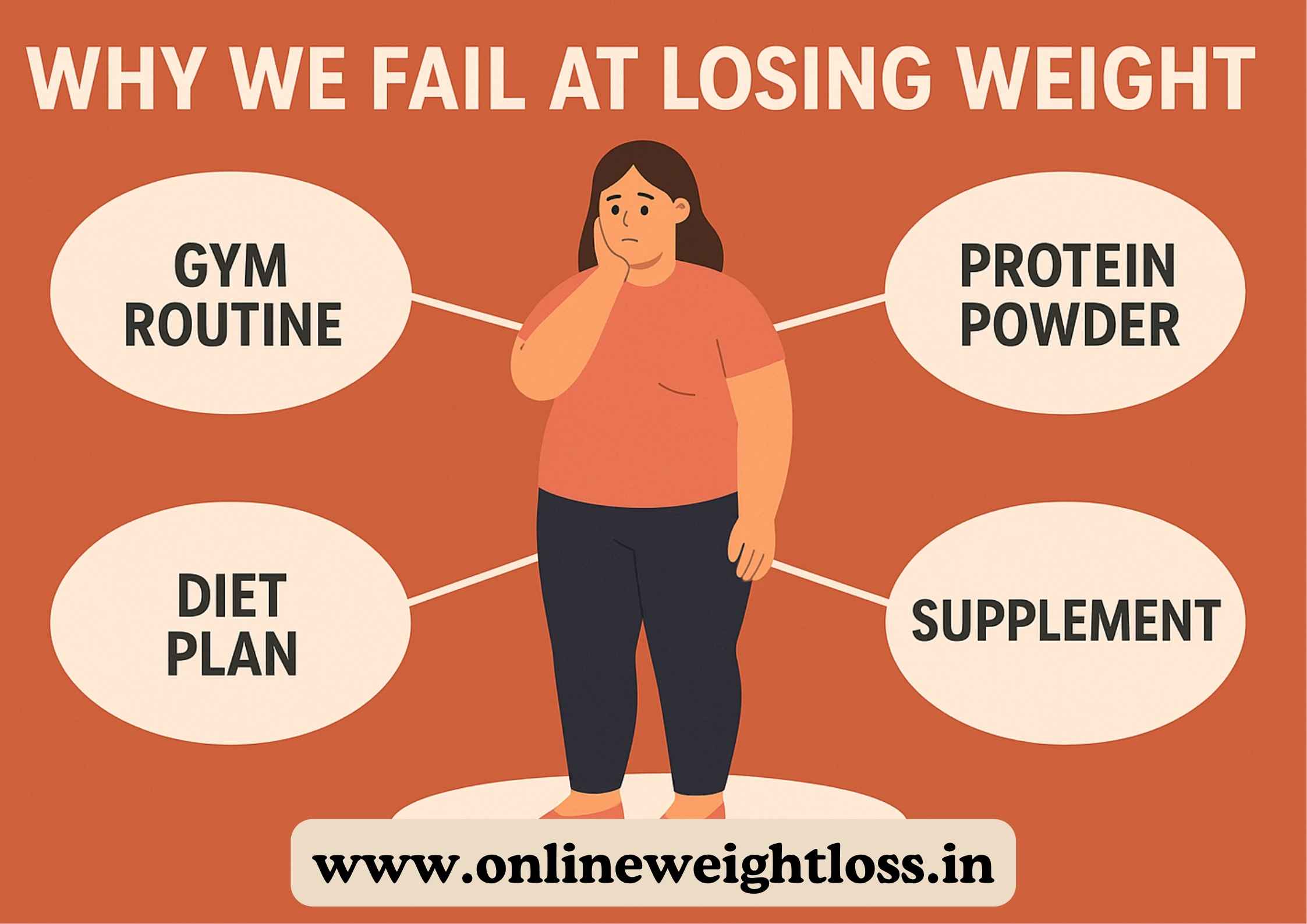
One major reason behind this failure is that they get caught up in simplified promises. Gym trainers, diet coaches and supplement sellers often say: “Do this one thing and you’ll lose weight.” However, the truth is that weight loss depends on multiple factors—not just a single routine, diet or pill. When you believe in one “silver bullet” solution, you set yourself up for partial results. That leads to progress for a moment, then stagnation or regain. In short, focused but narrow efforts are a common reason why most people fail to lose weight.
Metabolic & Biological Resistance to Weight Loss
Another key reason why most people fail to lose weight stems from how our body responds to weight loss. Research shows that when you lose weight, your metabolism slows down, your energy expenditure drops and your body often returns toward what’s called a “Set-point”.
For example, the article from Northwestern Medicine explains that the body often fights to maintain its previous weight, making regaining very likely. So, if you ignore this biological resistance, you may fail — this is why people who fail to lose weight often become a reflective question rather than a temporary result.
Lack of Balanced Foundations
When you severely cut calories, skip muscle maintenance, ignore daily movement, or neglect habit formation, you build on weak foundations. That’s a major reason why most people fail to lose weight or sustain it. Without balanced nutrition, adequate rest, moderate physical activity, and behavioural support, weight loss is fragile. When the structure is weak, the result is often short-lived.
Quick Fixes Lead to Long-Term Failure
Most of us are drawn to short-term solutions: extreme dieting, fad workouts, drastic cuts. These can lead to initial success — but they rarely address the root causes. That’s exactly why most people fail to lose weight, which becomes apparent once the novelty of the diet wears off. A crash diet may get you results for a month or two, but when the routine ends, the body returns.
How to Shift from Failure to Success
If you’re serious about breaking the cycle of weight regain, here’s a foundation you can build on:
- Create a sustainable plan: Instead of extreme restriction, aim for moderate changes you can stick with.
- Prioritise muscle and metabolism: Preserve lean body mass, move more throughout your day and don’t rely only on workouts for success.
- Address multiple factors: Diet, sleep, stress, movement, mindset — all matter.
- Set realistic expectations: Understand that the body may resist change and plan for the long-term.
- Monitor and adapt: Regularly check progress, tweak habits and maintain flexibility.
By doing so, you reduce the risk inherent in the very reasons why most people fail to lose weight.
Conclusion: Why Most People Fail to Lose Weight — And What You Can Do Differently
Understanding why most people fail to lose weight is key to choosing a different path. It’s not about blame or shame — it’s about design. Most people fail not because they are weak, but because they build something on weak foundations or follow only one dimension of a larger system. When you build your plan around multiple pillars — balanced nutrition, movement, metabolic support, habit formation — you give yourself a much stronger chance at lasting success. Let your new approach be one of sustainability, not shortcuts.
Related Resources
Read this expert overview from Harvard Health: Hidden Causes of Weight Gain — it sheds light on age, metabolism and why maintaining weight loss is often harder than losing it.
Explore our article on Why Accountability Matters in Weight Loss where we dive into how continuous monitoring of progress by an expert helps you to come out of the cycle of failure.
For Detailed Weight Loss Guidance, Read Our Complete Guide to Healthy Weight Loss.


3 thoughts on “Why Most People Fail to Lose Weight or End Up Regaining It?”
Comments are closed.